A Digital Twin (DT) is a virtual representation of a physical object, system, or process that is continuously updated with real-time data to mirror its behavior, performance, and state. It’s…
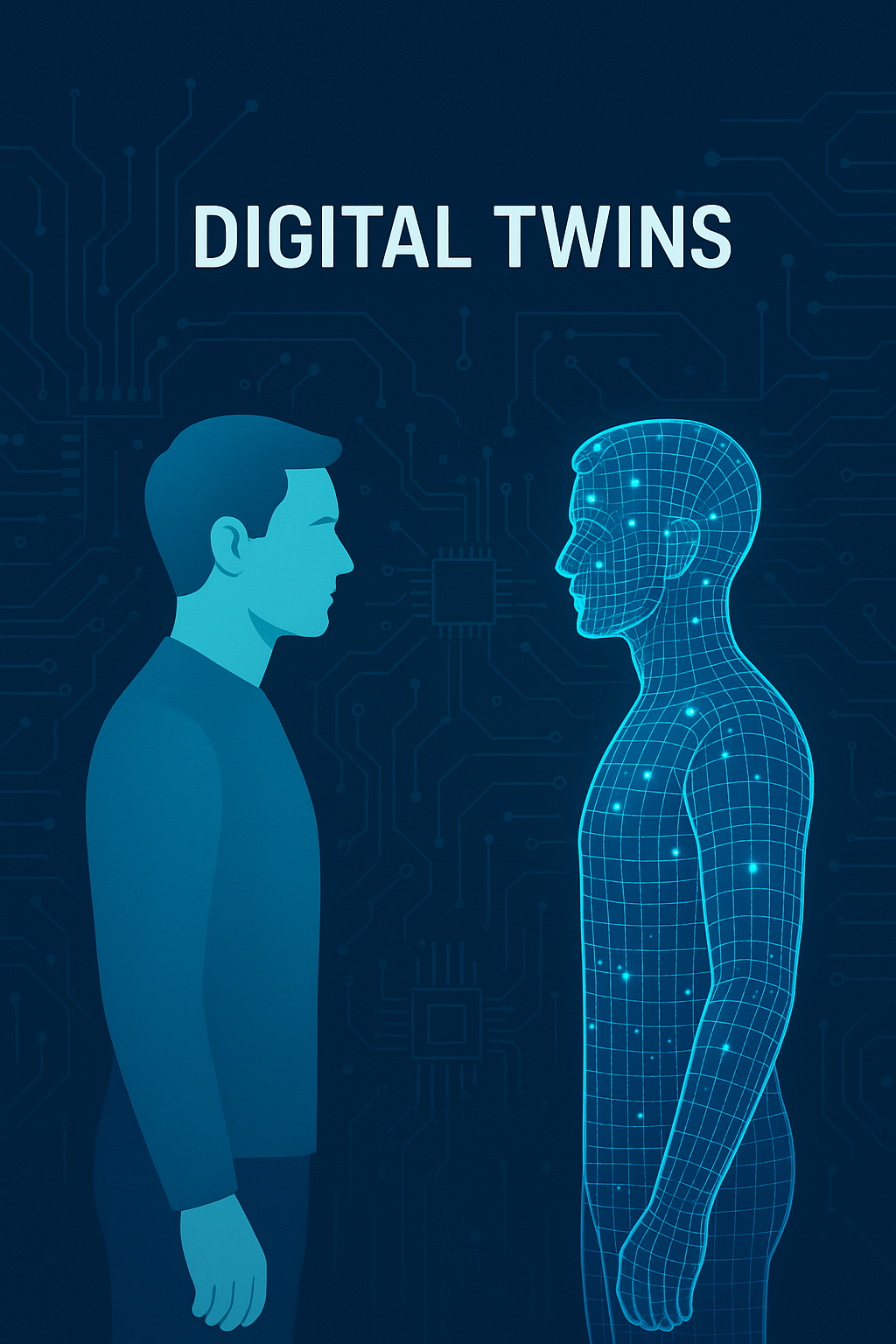
A Digital Twin (DT) is a virtual representation of a physical object, system, or process that is continuously updated with real-time data to mirror its behavior, performance, and state.
It’s not just a 3D model — it’s a living digital replica that evolves alongside its physical counterpart through sensors, data analytics, and AI.
In simple terms: A Digital Twin = Physical Asset + Digital Model + Real-time Data + Analytics + Feedback Loop.
Evolution and Conceptual Background
Generation
Description
Modeling & Simulation (Pre-2000s)
Static digital models used in design or testing.
Digital Shadows (2000–2010)
Models partially connected to real-time data but not bi-directional.
Digital Twins (2010–Now)
Fully dynamic, real-time digital counterparts with bi-directional communication.
Cognitive Digital Twins (Future)
Self-learning, autonomous twins using AI and machine reasoning.
The concept was first formalized by Dr. Michael Grieves (2002) in the context of Product Lifecycle Management (PLM). NASA used early forms of Digital Twins for spacecraft simulation.
Core Characteristics
Real-Time Connectivity: Continuous data flow between physical and digital entities.
Bidirectional Interaction: Changes in the physical asset reflect digitally, and digital optimizations can affect physical behavior.
High-Fidelity Modeling: Physics-based, AI-based, or hybrid models to accurately simulate real-world behavior.
Lifecycle Integration: Covers the asset’s entire life — design, production, operation, and disposal.
Intelligence & Learning: AI/ML enable prediction, optimization, and anomaly detection.
Components of a Digital Twin System
Component
Function
Physical Entity
The real-world object or system (e.g., machine, building, human body).
Digital Model
The virtual model representing geometry, physics, and behavior.
Sensors / IoT Devices
Collect real-time data (temperature, vibration, speed, pressure, etc.).
Connectivity Layer
Networks (Wi-Fi, 5G/6G, edge computing) that transmit sensor data.
Data & Analytics Platform
Processes, stores, and analyzes incoming data streams.
Simulation / AI Engine
Predictive models and simulations to test scenarios.
Actuation / Control Interface
Sends optimized commands or insights back to the physical system.
Architecture of a Digital Twin
A standard 5-layer architecture is often used:
Physical Layer: Real-world assets and IoT sensors.
Communication Layer: Data transmission via wireless/wired networks (5G, edge).
Data Layer: Storage, data lakes, and preprocessing pipelines.
Model Layer: Digital models, AI/ML, and simulation engines.
Application Layer: Dashboards, decision-making, visualization, and automation.
Types of Digital Twins
Type
Description
Example
Component Twin
Represents a single part or component.
Jet engine turbine blade.
Asset Twin
Digital copy of an entire asset/system.
A full car engine or pump.
Process Twin
Simulates workflows or operations.
Manufacturing assembly line.
System Twin
Represents multiple interacting assets.
Power grid, hospital system.
Human or Biological Twin
Digital twin of a person or organ.
Human heart, patient digital twin.
City/Environment Twin
Models urban areas and infrastructure.
Smart city simulation (e.g., Singapore).
Key Technologies Enabling Digital Twins
Technology
Role
Internet of Things (IoT)
Collects real-time sensor data.
5G / 6G Networks
Enables ultra-low-latency, high-speed data transmission.
Edge & Cloud Computing
Processes large volumes of real-time data.
Artificial Intelligence & Machine Learning
Predicts future behavior, detects anomalies.
Big Data Analytics
Stores and analyzes massive datasets from connected devices.
Simulation & Modeling Software
CAD, CFD, finite element modeling.
AR/VR and 3D Visualization
Immersive representation of the digital twin.
Blockchain
Secure data exchange and provenance tracking.
Digital Thread
Provides seamless data flow throughout product lifecycle.
How a Digital Twin Works — Data Flow
Data Generation: IoT sensors capture data from the physical world.
Data Transmission: Data sent via communication network (5G/6G, Wi-Fi, LPWAN).
Data Integration: Collected data is stored in a cloud or edge database.
Model Synchronization: The digital model updates continuously using AI/analytics.
Simulation & Prediction: System tests virtual scenarios to predict outcomes.
Decision & Feedback: Insights are fed back to optimize real-world performance.
Applications Across Industries
Manufacturing & Industry 4.0
Predictive maintenance of machines.
Process optimization for yield and quality.
Virtual commissioning and testing of production lines.
Lifecycle management from design to disposal.
Example: Siemens MindSphere, GE Predix.
Automotive and Aerospace
Design and test vehicles or aircraft in virtual space.
Real-time performance monitoring (engine health).
Flight and vehicle simulation for safety and optimization.
Example: Rolls-Royce uses DTs to monitor jet engines in operation.
Smart Cities and Infrastructure
City-scale twins simulate traffic, water, and energy systems.
Enables urban planning, pollution control, and disaster management.
Example: Singapore’s “Virtual Singapore” — a full 3D model of the city.
Energy and Utilities
Optimize power generation, grid distribution, and fault detection.
Monitor renewable energy sources like wind turbines and solar farms.
Example: BP and Shell use DTs for oil field management and predictive maintenance.
Healthcare and Life Sciences
Patient Digital Twins: Personalized simulations of organs or entire bodies.
Predict disease progression and test treatment plans.
Optimize surgical procedures via virtual rehearsals.
Example: Philips HealthSuite, Dassault Systèmes Living Heart Project.
Construction and Real Estate (BIM Integration)
Building Information Modeling (BIM) + DT for energy efficiency and maintenance.
Detect design flaws before construction.
Manage facility operations digitally.
Aerospace & Defense
Twin satellites and aircraft for monitoring and mission planning.
Simulate harsh environments (space, deep sea) virtually.
Environmental Monitoring
Digital twins for forests, oceans, and climate systems.
Leave a Reply