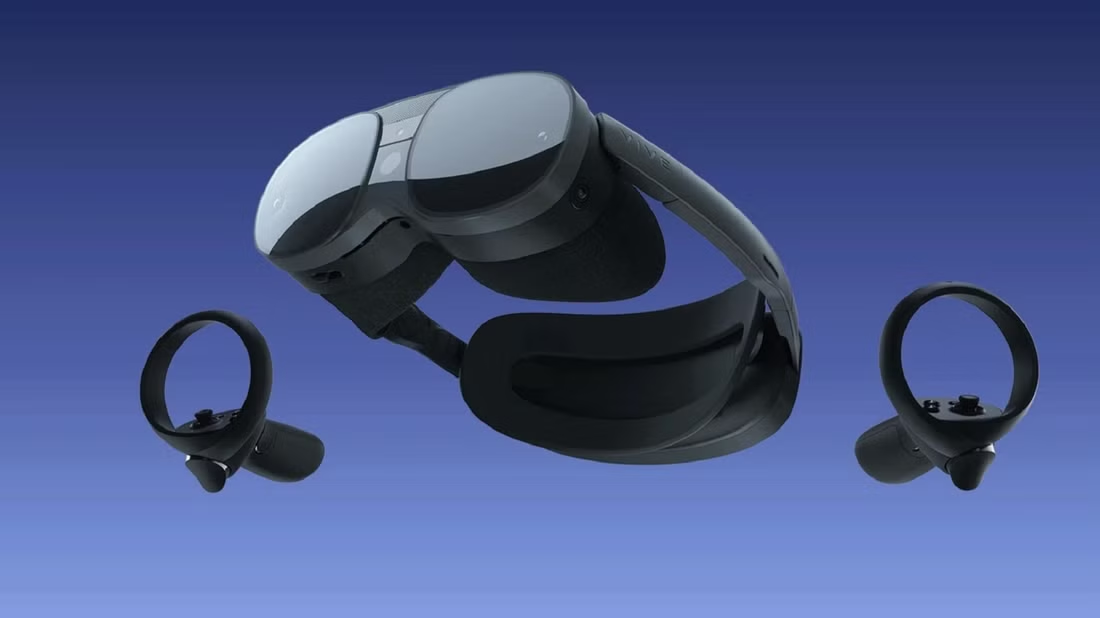
Extended Reality, commonly referred to as XR, is a transformative field of immersive technology that blends the physical and digital worlds, creating new environments where digital information and virtual environments can be experienced as naturally as the real world. XR is an umbrella term that includes Virtual Reality, Augmented Reality, and Mixed Reality. These technologies reshape how humans see, interact with, and understand information, turning screens from rigid windows into flexible, surrounding experiences. Instead of viewing the digital world from a distance, XR invites people to step inside it, blur its boundaries, or bring its elements into everyday physical spaces.
Virtual Reality represents the most immersive form of XR. It transports a user entirely into a computer-generated world using headsets, motion controllers, and sometimes full-body suits or tracking systems. Inside VR, real-world surroundings disappear, replaced by a fully simulated environment, whether it is a virtual classroom, a battlefield simulation, a fantasy world, or the inside of the human body for medical training. VR is already revolutionizing education and professional training by allowing learners to practice surgeries, pilot aircraft, build machinery, and navigate dangerous scenarios without real-world risks. In entertainment, VR opens the door to immersive games, storytelling worlds, interactive cinema, and social virtual spaces where people can hang out, work, or attend concerts as digital avatars. It is not merely a display technology; it is a new dimension of human presence.
Augmented Reality, in contrast, keeps users grounded in the real world while enhancing it with digital overlays. Instead of replacing reality, AR adds context, information, and interactive virtual objects on top of it. Smartphones and AR glasses superimpose digital text, 3D objects, and animated visuals onto physical environments, enabling someone to navigate streets with virtual arrows floating in front of them, learn anatomy through 3D organs hovering above a desk, try clothes virtually, or visualize how furniture will look in a room before buying it. AR supports industry and logistics by guiding workers through complex assembly tasks with step-by-step digital instructions floating in the air. It extends into retail, tourism, healthcare, and education, turning the entire world into a creative interface layered with real-time knowledge.
Mixed Reality goes a step further by merging digital and physical elements so deeply that virtual objects appear anchored in the real world and can interact with it. Unlike AR, where digital visuals simply overlay reality, MR blends both worlds so users can treat digital content as if it were physically present. For instance, a designer wearing MR glasses can place a holographic machine on a table, walk around it, disassemble its components with gestures, and collaborate with a colleague in another country who sees the same hologram. MR is used for advanced industrial design, remote assistance, collaborative engineering, and complex problem solving in environments where digital models must align precisely with real-world objects. It feels like digital matter sharing physical space.
XR technologies depend on advanced sensors, spatial mapping, artificial intelligence, real-time rendering, and powerful computing. Devices track head movement, eye gaze, hand gestures, and environmental geometry to create convincing, responsive experiences. Future XR systems will use lightweight glasses, neural interfaces, haptic gloves, volumetric displays, and AI-generated worlds that adapt to the user’s behavior. As networks evolve — especially with the rise of edge computing and ultra-fast connectivity — XR experiences will become more fluid, social, and persistent, meaning digital elements will continue to exist and evolve in shared spaces even after users leave.
Extended Reality is more than a new form of media; it marks the beginning of spatial computing, where the digital world breaks free from screens and integrates naturally into physical life. It transforms how people learn, work, play, socialize, shop, design, heal, and imagine. Challenges remain, including device comfort, cost, software maturity, safety, and ethical concerns about privacy and digital identity. Yet the momentum is undeniable. XR is gradually building a future where human experience is no longer limited to biological senses or physical environments — a future where imagination becomes a dimension one can walk into, interact with, and share with others.
Leave a Reply